Dry Ice Blasting vs. Pressure Washing for Heavy Equipment
Keeping heavy equipment clean is an important part of industrial maintenance, especially in demanding environments such as construction sites, asphalt plants, concrete production facilities, and manufacturing operations.
Machinery regularly accumulates grease, oil, dust, mud, production residue, and other contaminants that can make inspections difficult and increase maintenance requirements.
Two cleaning methods commonly considered for industrial machinery are dry ice blasting and pressure washing.
Both can remove certain types of surface contamination, but they differ significantly in their cleaning media, equipment requirements, moisture exposure, waste management, and suitability for sensitive components.
Understanding dry ice blasting vs. pressure washing helps maintenance teams choose an appropriate method based on the equipment, contamination, operating environment, and cleaning objectives.
This guide compares the two methods, explains their advantages and limitations, and explores when dry ice blasting may be a practical alternative for heavy equipment cleaning.
What Is Dry Ice Blasting?
Dry ice blasting is an industrial cleaning process that uses compressed air to propel solid carbon dioxide (CO₂) pellets toward contaminated surfaces.
When the pellets strike a surface, they transfer kinetic energy and rapidly sublimate, changing directly from solid carbon dioxide into gas.
This action helps loosen and dislodge certain contaminants from compatible materials.
Unlike conventional abrasive blasting, dry ice blasting does not introduce sand, grit, or other hard abrasive particles that must be collected after cleaning.
It also does not require water as its cleaning medium.
Dry ice blasting is used in various industrial cleaning applications, including suitable external machinery surfaces, mechanical assemblies, manufacturing equipment, and maintenance areas.
Common contaminants that may respond to dry ice blasting include:
- Grease and oil deposits
- Dirt and accumulated grime
- Certain adhesive residues
- Selected production residues
- Some loosely adhered surface deposits
- Contamination around mechanical housings and brackets
However, effectiveness depends on the contamination, adhesion, equipment settings, and surface condition.
Dry ice blasting is not universally suitable for removing thick hardened concrete, heavily bonded asphalt, or substantial corrosion.
For more information about industrial applications, explore Nu-Ice’s Asphalt & Concrete Industry resource.
What Is Pressure Washing?
Pressure washing uses a high-pressure stream of water to remove dirt, mud, grease, and other contaminants from surfaces.
Depending on the application, operators may use heated water, detergents, or specialized cleaning attachments.
Pressure washing is widely used for cleaning construction machinery, vehicles, concrete surfaces, industrial equipment, and outdoor facilities.
It is particularly useful for removing:
- Mud and soil
- Loose dirt and dust
- Water-soluble contamination
- Certain grease and oil deposits when suitable detergents are used
- General environmental buildup
However, pressure washing introduces moisture and may produce contaminated wastewater that requires containment or treatment.
High-pressure water can also damage vulnerable seals, coatings, electrical components, and other sensitive materials when used incorrectly.
Dry Ice Blasting vs. Pressure Washing: Key Differences
Although both methods are used for industrial equipment cleaning, they have different operating characteristics.
| Feature | Dry Ice Blasting | Pressure Washing |
|---|---|---|
| Cleaning medium | Solid CO₂ pellets and compressed air | Pressurized water |
| Water introduced | No water used as the blasting medium | Yes |
| Cleaning action | Pellet impact, thermal effects, and sublimation | Water impact and flushing |
| Grease and oil removal | Effective for many suitable surface deposits | Often effective with detergents or heated water |
| Mud and loose dirt | Possible, but may be less practical for large volumes | Generally well suited |
| Sensitive components | Requires compatibility assessment and protection | Requires moisture and pressure precautions |
| Spent cleaning media | No spent dry ice pellets | Wastewater remains |
| Contaminant cleanup | Dislodged material must be collected | Contaminated water and debris must be managed |
| Equipment requirements | Dry ice blaster, compressed air, dry ice supply | Pressure washer, water supply, drainage or containment |
| Surface compatibility | Depends on pressure, temperature effects, and material condition | Depends on water pressure, temperature, and material condition |
| Main safety concerns | CO₂ accumulation, noise, flying debris, cold exposure | Injection injuries, electrical hazards, slippery surfaces, wastewater |
| Typical applications | Selected industrial machinery and moisture-sensitive cleaning tasks | General exterior equipment washing and bulk dirt removal |
Neither method is automatically better for every cleaning task.
The appropriate choice depends on the equipment, contamination, workplace conditions, and maintenance requirements.
Benefits of Dry Ice Blasting for Heavy Equipment Cleaning
1. Minimizes Water Exposure
One of the main differences between dry ice blasting and pressure washing is the use of water.
Pressure washing introduces moisture that may reach electrical connections, bearings, exposed metal surfaces, and other components.
Dry ice blasting does not require water as its cleaning medium.
This can be advantageous when cleaning compatible machinery surfaces where minimizing moisture exposure is important.
However, dry ice blasting does not eliminate all risks to sensitive components.
Condensation, temperature changes, and the mechanical force of the blasting stream must still be considered.
2. Eliminates Spent Blasting Media
Dry ice pellets sublimate into carbon dioxide gas during cleaning.
Unlike sand or other conventional abrasive blasting materials, they do not leave spent blasting media behind.
This can simplify cleanup around machinery with complex surfaces or restricted access.
However, the contaminants removed from the equipment remain.
Oil, grease, dust, coating fragments, and other dislodged materials must still be collected and disposed of appropriately.
3. Supports Cleaning Around Suitable Mechanical Assemblies
Industrial machinery contains housings, brackets, frames, and other irregular surfaces that can be difficult to clean manually.
Dry ice blasting may help remove contamination from compatible external assemblies without requiring water-based rinsing.
This can support routine inspection and maintenance activities.
Nevertheless, exposed electronics, damaged seals, fragile coatings, and other vulnerable components must be protected or avoided.
4. May Reduce Drying Requirements
Pressure washing introduces water that may require draining, drying, or additional inspection before machinery returns to service.
Dry ice blasting does not require water-based rinsing.
For suitable applications, this may reduce the drying stage of the cleaning process.
However, equipment must still undergo appropriate post-cleaning inspection, and condensation remains possible.
5. Can Complement Preventive Maintenance
Accumulated grease and dirt can obscure leaks, damaged fittings, deteriorated coatings, and other maintenance concerns.
Dry ice blasting can help remove suitable contamination from accessible machinery surfaces.
This may improve visibility during inspections and support preventive maintenance programs.
It does not replace mechanical servicing, repair, or equipment-specific maintenance procedures.
Benefits of Pressure Washing for Heavy Equipment
Pressure washing remains an effective and widely used cleaning method for industrial machinery.
1. Effective for Mud and Bulk Dirt Removal
Construction machinery and heavy equipment frequently accumulate mud, soil, and loose environmental contamination.
Pressure washing is often well suited to removing large volumes of these materials from compatible exterior surfaces.
For heavily soiled construction equipment, water-based cleaning may be more practical than dry ice blasting.
2. Useful for General Exterior Cleaning
Pressure washing can clean large external surfaces such as equipment frames, vehicle bodies, tracks, and other compatible components.
The appropriate pressure, nozzle, and cleaning distance depend on the surface and manufacturer recommendations.
3. Can Use Heated Water and Detergents
Certain pressure washing systems use heated water or approved detergents to improve grease and oil removal.
This can make pressure washing effective for applications where water and cleaning chemicals are acceptable.
However, detergents and contaminated wastewater require appropriate handling.
4. Suitable for Many Outdoor Cleaning Operations
Pressure washing is commonly used in outdoor environments where water supply, drainage, and wastewater controls are available.
For general equipment washing, it may be a practical choice when moisture exposure is not a concern.
Which Heavy Equipment Cleaning Method Is Better for Different Applications?
The best cleaning method depends on the equipment and contamination.
Construction Equipment
Excavators, loaders, bulldozers, and other construction machinery often accumulate mud, soil, grease, and hydraulic oil.
Pressure washing is generally practical for removing heavy mud and loose dirt from compatible exterior surfaces.
Dry ice blasting may be useful for selected mechanical housings, brackets, and other areas where minimizing water exposure is important.
A combination of cleaning methods may be appropriate.
Asphalt Production and Paving Equipment
Asphalt machinery can accumulate grease, oil, dust, and bitumen-related residue.
Dry ice blasting may help clean compatible external components and certain surface deposits.
Pressure washing may be useful for removing loose dirt and other water-removable contamination.
However, thick hardened asphalt deposits may require specialized removal methods rather than either cleaning technique alone.
Concrete Production Equipment
Concrete mixers, batching plants, and construction machinery can accumulate cement dust, grease, and concrete residue.
Pressure washing is commonly used for general cleaning when water exposure is acceptable.
Dry ice blasting may help remove grease and suitable surface contamination from compatible external components.
Neither method should be assumed to remove substantial amounts of fully cured concrete effectively.
Hardened concrete buildup often requires mechanical or specialized cleaning procedures.
Manufacturing and Industrial Machinery
Manufacturing equipment may contain electrical assemblies, precision components, and mechanical systems where moisture exposure is undesirable.
Dry ice blasting can be considered for compatible external surfaces when appropriate safety precautions are followed.
Pressure washing may be suitable for machinery specifically designed to tolerate water-based cleaning.
Manufacturer instructions and component compatibility should determine the cleaning method.
Agricultural Equipment
Agricultural machinery accumulates soil, plant material, grease, and environmental contamination.
Pressure washing is often practical for removing heavy dirt from compatible exterior surfaces.
Dry ice blasting may be useful for selected grease deposits and external mechanical assemblies.
Sensitive bearings, electrical systems, seals, and protective coatings require appropriate precautions with either method.
Dry Ice Blasting vs. Pressure Washing for Grease and Oil Removal
Grease and oil are common contaminants on heavy equipment.
Both dry ice blasting and pressure washing can remove certain grease and oil deposits, but their effectiveness depends on the contamination and cleaning conditions.
Dry ice blasting uses pellet impact and thermal effects to loosen deposits from compatible surfaces.
Pressure washing uses water impact and flushing, sometimes supported by heated water or detergents.
For selected machinery components where minimizing water exposure is important, dry ice blasting may offer practical advantages.
For large exterior surfaces where water and detergents are acceptable, pressure washing may be more economical or convenient.
Neither method guarantees complete removal of every grease or oil deposit.
Which Method Is Better for Sensitive Equipment?
Heavy equipment may contain electrical connectors, sensors, hydraulic systems, bearings, seals, and other components requiring careful cleaning.
Dry ice blasting does not introduce water, which can be useful when moisture exposure is undesirable.
However, it is not automatically safe for sensitive equipment.
The blasting stream can damage fragile components, dislodge connections, or affect vulnerable coatings.
Pressure washing can also damage components through high water pressure or moisture intrusion.
Before cleaning sensitive machinery, operators should:
- Review manufacturer cleaning instructions
- Identify vulnerable components
- Assess the surface condition
- Protect exposed openings and connections
- Select appropriate cleaning settings
- Test a suitable area
- Follow equipment shutdown and isolation procedures
The safest cleaning method depends on the specific machinery and its condition.
Cost Comparison: Dry Ice Blasting vs. Pressure Washing
Cost is an important consideration when comparing heavy equipment cleaning methods.
Dry ice blasting and pressure washing have different equipment, consumable, labor, and waste-management requirements.
Dry Ice Blasting Costs
Dry ice blasting operations may involve:
- Equipment purchase or rental
- Compressed-air supply
- Dry ice pellets
- Operator labor
- Equipment maintenance
- Ventilation and safety controls
- Contaminant collection and disposal
Dry ice blasting may reduce certain rinsing and drying requirements, but the equipment and consumables can represent significant operating costs.
Pressure Washing Costs
Pressure washing operations may involve:
- Equipment purchase or rental
- Water consumption
- Electricity or fuel
- Detergents where required
- Operator labor
- Wastewater collection and treatment
- Equipment maintenance
- Drying and post-cleaning inspection
Pressure washing may have lower consumable costs for certain general cleaning tasks, but wastewater handling and drying requirements can increase total costs.
Which Method Is More Cost-Effective?
Neither method is universally cheaper.
The total cost depends on:
- Equipment size and accessibility
- Type and severity of contamination
- Cleaning frequency
- Labor requirements
- Available utilities
- Dry ice availability
- Wastewater management requirements
- Downtime and production schedules
Businesses should compare the total cost of completing a specific cleaning task rather than equipment purchase prices alone.
Environmental Considerations
Dry ice blasting and pressure washing have different environmental impacts.
Dry ice blasting does not use water as its cleaning medium and does not produce spent dry ice pellets.
This can reduce water consumption and avoid wastewater generation associated with the cleaning process.
However, dry ice blasting uses carbon dioxide that is released into the surrounding environment during sublimation.
Its overall environmental impact depends on factors such as CO₂ sourcing, dry ice production, transportation, compressed-air energy use, and contaminant disposal.
Pressure washing uses water and may require detergents or heated water.
Its environmental impact depends on water consumption, energy use, cleaning chemicals, and wastewater treatment.
Neither method should automatically be described as environmentally harmless.
The appropriate choice depends on the application and the environmental factors being evaluated.
Safety Considerations for Industrial Equipment Cleaning
Carbon Dioxide Ventilation
Dry ice blasting releases carbon dioxide gas during operation.
In enclosed or poorly ventilated areas, CO₂ can accumulate and create an asphyxiation hazard.
Adequate ventilation, workplace risk assessment, and CO₂ monitoring where necessary are essential.
High-Pressure Water Hazards
Pressure washing equipment can cause serious injuries, including high-pressure injection injuries.
Operators should follow equipment instructions, maintain safe nozzle distances, and use appropriate protective equipment.
Electrical and Mechanical Hazards
Both cleaning methods require precautions around electrical systems, moving machinery, hydraulic pressure, and stored energy.
Equipment should be shut down and isolated according to applicable lockout/tagout procedures.
Airborne Contaminants
Dry ice blasting can dislodge dust, grease, coatings, and other materials.
Where hazardous dust or substances may become airborne, appropriate exposure controls and respiratory protection may be necessary.
Waste Management
Dry ice blasting leaves dislodged contamination that must be collected.
Pressure washing produces wastewater that may contain oil, grease, chemicals, and other contaminants.
Both processes require appropriate waste-handling procedures.
Choosing a Dry Ice Blasting Machine for Heavy Equipment Cleaning
Businesses considering dry ice blasting should select equipment based on their cleaning applications.
Important considerations include:
- Available compressed-air pressure and flow
- Adjustable blasting pressure
- Dry ice feed rate control
- Nozzle configurations
- Equipment portability
- Dry ice consumption
- Cleaning frequency
- Surface compatibility
- Ventilation requirements
- Operating and maintenance costs
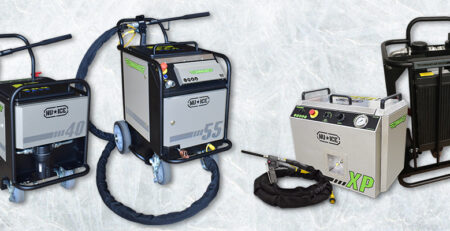
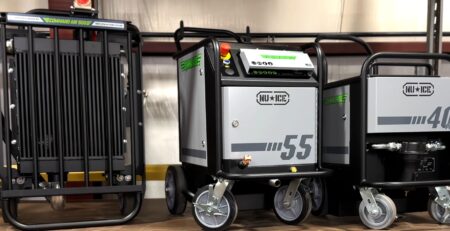
Nu-Ice manufactures American-made COMMANDO® dry ice blasting machines for industrial cleaning applications.
The COMMANDO® range provides equipment options for businesses evaluating dry ice blasting as part of their maintenance operations.
Selecting the appropriate machine depends on the equipment being cleaned, the contaminants involved, and the available compressed-air supply.
Explore Nu-Ice’s Dry Ice Blasting Machines range or contact the Nu-Ice team to discuss your industrial cleaning requirements.
Frequently Asked Questions
Is dry ice blasting better than pressure washing?
Dry ice blasting may be preferable when minimizing water exposure, wastewater, or spent blasting media is important. Pressure washing is often more practical for removing mud and loose dirt from large exterior surfaces. The best method depends on the cleaning application.
Can dry ice blasting remove grease better than pressure washing?
Both methods can remove certain grease deposits. Dry ice blasting may offer advantages for compatible machinery surfaces where water exposure is undesirable, while heated pressure washing with suitable detergents can be effective for heavy grease removal.
Does dry ice blasting damage heavy equipment?
Dry ice blasting can clean many compatible surfaces without intentionally removing the underlying material. However, inappropriate pressure, nozzle selection, or exposure can damage vulnerable coatings and components.
Is dry ice blasting more expensive than pressure washing?
Dry ice blasting may involve higher equipment and consumable costs for certain applications. However, total cleaning costs depend on labor, downtime, wastewater management, and other operating factors.
Can dry ice blasting clean construction equipment?
Yes. Dry ice blasting may be useful for cleaning suitable external components of construction machinery, including mechanical housings, brackets, and areas with grease or oil contamination.
Does dry ice blasting use water?
No. Dry ice blasting uses solid carbon dioxide pellets and compressed air rather than water as its cleaning medium. However, condensation may still occur under certain conditions.
Does pressure washing damage electrical components?
Pressure washing can introduce moisture into vulnerable electrical connections, sensors, and other components. Appropriate protection and manufacturer-approved cleaning procedures are necessary.
Which cleaning method produces less waste?
Dry ice blasting produces no spent dry ice blasting media, but dislodged contaminants still require collection. Pressure washing produces wastewater that may require containment and treatment. The overall waste impact depends on the application.
Find the Right Industrial Cleaning Solution With Nu-Ice
Choosing between dry ice blasting and pressure washing depends on the machinery, contamination, operating environment, and maintenance requirements.
Pressure washing remains an effective option for general exterior cleaning, mud removal, and applications where water exposure is acceptable.
Dry ice blasting offers an alternative for cleaning suitable industrial machinery surfaces without introducing water or conventional abrasive blasting media.
For businesses maintaining construction machinery, asphalt equipment, concrete production systems, and other industrial assets, understanding these differences can help support more informed cleaning decisions.
Nu-Ice manufactures American-made COMMANDO® dry ice blasting machines designed for a variety of industrial cleaning applications.
Looking for dry ice blasting equipment for your heavy equipment maintenance operations?
Explore Nu-Ice’s Dry Ice Blasting Machines or contact the Nu-Ice team to discuss your cleaning applications, equipment requirements, and available options.