Choosing a Dry Ice Blasting Machine for Asphalt & Concrete Operations
Asphalt plants, concrete production facilities, and construction contractors rely on heavy equipment that operates in demanding industrial environments. Grease, oil, dust, production residue, and other contaminants can accumulate on machinery, making routine inspections and maintenance more difficult.
Selecting the right industrial dry ice blasting machine can help maintenance teams remove suitable surface contamination while minimizing the use of water and conventional abrasive blasting media.
However, not every dry ice blaster is designed for the same cleaning requirements. Equipment varies in blasting pressure, compressed-air demand, dry ice capacity, portability, and operating controls.
For asphalt and concrete operations, choosing appropriate dry ice blasting equipment requires understanding the contaminants being removed, the machinery involved, and the limitations of the cleaning process.
This guide explains the key factors to consider when selecting a dry ice blasting machine, compares industrial equipment configurations, and explores the Nu-Ice COMMANDO® range for professional cleaning applications.
What Is an Industrial Dry Ice Blasting Machine?
An industrial dry ice blasting machine uses compressed air to propel solid carbon dioxide (CO₂) pellets toward contaminated surfaces.
When the pellets strike a surface, they transfer energy and rapidly sublimate, changing directly from solid carbon dioxide into gas.
This action helps loosen and dislodge certain contaminants without introducing water or conventional abrasive blasting media.
Unlike sandblasting, dry ice blasting generally focuses on removing surface contamination rather than intentionally altering the underlying material.
For asphalt and concrete operations, a dry ice blaster may be useful for cleaning suitable external machinery surfaces, mechanical housings, structural brackets, and accessible maintenance areas.
Common applications include removing:
- Grease and oil deposits
- Dirt and accumulated grime
- Selected production residues
- Certain loosely adhered asphalt-related deposits
- Release agent residue on compatible surfaces
- Contamination around mechanical assemblies
However, dry ice blasting is not a universal solution for hardened asphalt, fully cured concrete, heavy corrosion, or strongly bonded mineral deposits.
For additional information about these applications, explore Nu-Ice’s Asphalt & Concrete Industry resource.
Why Equipment Selection Matters for Asphalt & Concrete Operations
Asphalt and concrete facilities contain different types of machinery, each with specific cleaning requirements.
An asphalt plant may need to clean grease-covered mechanical assemblies, external mixer housings, conveyor supports, and production equipment.
A concrete batching facility may need to remove oil, dirt, cement dust, and release agent residue from compatible external surfaces.
These applications vary in contamination severity, accessibility, surface condition, and cleaning frequency.
Selecting the appropriate industrial dry ice blasting machine helps ensure that the equipment can deliver the required cleaning performance without exceeding the available compressed-air capacity or exposing vulnerable components to unnecessary risk.
The largest or most powerful machine is not automatically the best choice.
Equipment should be matched to the intended application.
Key Factors to Consider When Choosing a Dry Ice Blasting Machine
1. Type of Contamination
The first consideration is identifying the material that needs to be removed.
Dry ice blasting can be effective for many types of grease, oil, dirt, and suitable surface residue.
However, cleaning performance depends on the contaminant’s thickness, adhesion, temperature, and underlying surface.
For asphalt operations, heavily bonded bitumen may require specialized removal techniques.
For concrete operations, thick or fully cured concrete deposits generally require mechanical or dedicated concrete removal methods.
Before investing in equipment, operators should determine whether dry ice blasting is appropriate for their actual cleaning requirements.
A controlled cleaning demonstration can help establish suitability.
2. Blasting Pressure and Cleaning Control
Blasting pressure affects the energy delivered to a contaminated surface.
Different applications may require different operating pressures.
For example, removing grease from a robust metal housing may require a different cleaning configuration than removing residue from a coated component.
Machines with adjustable blasting pressure allow operators to adapt the cleaning process to the surface and contamination.
However, higher pressure does not always produce better results.
Excessive pressure may damage vulnerable coatings, seals, and other components.
Operators should begin with conservative settings and follow equipment manufacturer recommendations.
3. Compressed-Air Requirements
Compressed-air supply is one of the most important factors when selecting a dry ice blasting machine.
Dry ice blasters require sufficient airflow and pressure to propel pellets through the blasting system.
A machine’s performance depends on the available air supply, nozzle configuration, hose arrangement, and operating settings.
Before purchasing equipment, operators should confirm:
- Available compressor pressure
- Continuous airflow capacity
- Air quality and moisture control
- Air hose diameter and length
- Connection compatibility
- Expected operating conditions
An industrial compressor must be capable of meeting the selected machine’s requirements.
Insufficient airflow may limit cleaning performance even when the compressor can reach the required pressure.
4. Dry Ice Hopper Capacity
The hopper holds the dry ice pellets used during blasting.
Machines with larger hoppers can accommodate more dry ice before refilling.
This may be useful for extended cleaning operations at asphalt plants, concrete production facilities, and industrial maintenance sites.
However, hopper capacity alone does not determine operating time.
Actual operating duration depends on dry ice feed rate, cleaning settings, and the work being performed.
5. Dry Ice Consumption
Dry ice consumption affects operating costs and the amount of dry ice required for each cleaning project.
Machines with adjustable pellet feed rates allow operators to control the quantity of dry ice delivered during blasting.
This can be useful when switching between lighter surface contamination and more demanding cleaning tasks.
However, reducing dry ice consumption does not automatically improve overall efficiency if cleaning takes significantly longer.
Equipment should be evaluated based on the total resources required to complete the cleaning task.
6. Nozzle Selection
Nozzles influence how the blasting stream reaches the surface.
Different nozzle configurations may be useful for broad external equipment surfaces, restricted access areas, or more concentrated cleaning tasks.
For asphalt and concrete machinery, suitable nozzle options may help operators reach:
- Equipment frames
- Structural brackets
- External housings
- Mechanical assemblies
- Maintenance access points
- Selected areas around machinery supports
The correct nozzle depends on the surface, contamination, airflow, and equipment configuration.
7. Portability and Equipment Access
Industrial cleaning operations may require equipment to be moved between production areas or transported to different job sites.
Portability can be important for contractors maintaining asphalt pavers, concrete machinery, and other construction equipment.
When evaluating portability, consider:
- Machine weight
- Overall dimensions
- Wheel and handle configuration
- Hose length
- Access to compressed air
- Transportation requirements
- Working clearance around equipment
A portable machine may be advantageous for maintenance teams working across multiple locations.
However, portability should be balanced against cleaning performance and operating capacity.
8. Maintenance and Serviceability
Industrial cleaning equipment should be evaluated for its ongoing maintenance requirements.
Important considerations include:
- Access to replacement parts
- Blasting hose maintenance
- Nozzle replacement
- Hopper and feeding system maintenance
- Availability of technical support
- Ease of servicing components
- Warranty coverage
Selecting equipment that can be maintained efficiently may help reduce interruptions during scheduled cleaning operations.
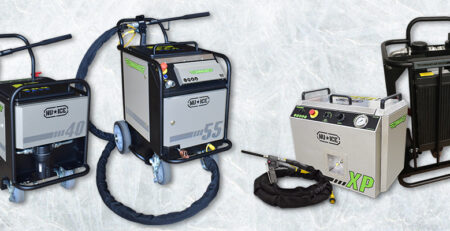
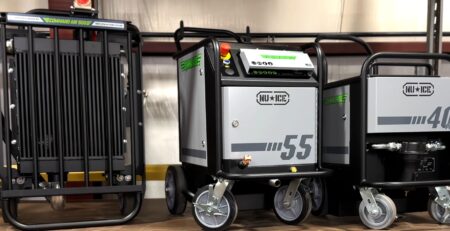
Comparing Nu-Ice COMMANDO® Dry Ice Blasting Machines
Nu-Ice manufactures American-made COMMANDO® dry ice blasting machines for industrial, commercial, and precision cleaning applications.
The range includes equipment designed for different operating requirements, from portable industrial cleaning to extended heavy-duty blasting operations.
Nu-Ice COMMANDO® 40 PRO
The COMMANDO® 40 PRO is an all-pneumatic dry ice blasting machine designed for industrial cleaning professionals who need portability and adjustable cleaning controls.
Because the machine operates using compressed air, it does not require a separate electrical power connection.
Key specifications include:
- Hopper capacity: 40 lbs (18 kg)
- Blasting pressure: 60–250 psi
- Operating airflow range: 85–375 CFM
- Dry ice consumption: up to 240 lbs/hr
- Adjustable blasting pressure and pellet feed rate
- Machine weight: 162 lbs (73.5 kg)
The COMMANDO® 40 PRO may be worth evaluating for maintenance contractors and industrial facilities that need a portable machine with adjustable blasting performance.
Its suitability for specific asphalt or concrete equipment depends on the contamination, available compressed air, and surface compatibility.
Nu-Ice COMMANDO® 55
The COMMANDO® 55 is designed for demanding industrial and commercial cleaning applications.
It features a larger dry ice hopper and increased airflow capacity for heavy-duty cleaning requirements.
Key specifications include:
- Hopper capacity: 55 lbs (25 kg)
- Blasting pressure: 60–250 psi
- Operating airflow range: 85–375 CFM
- Dry ice consumption: up to 425 lbs/hr
- Adjustable blasting pressure and pellet feed rate
- Machine weight: 234 lbs (106 kg)
- Electrical power required
The COMMANDO® 55 may be appropriate for facilities evaluating equipment for more demanding cleaning applications.
However, higher blasting capacity does not guarantee removal of hardened asphalt or cured concrete.
Nu-Ice COMMANDO® 80
The COMMANDO® 80 is designed for extended industrial and commercial cleaning operations.
Its larger hopper supports longer cleaning sessions between refills, depending on the selected dry ice feed rate.
Key specifications include:
- Hopper capacity: 80 lbs (36 kg)
- Blasting pressure: 60–250 psi
- Operating airflow range: 85–375 CFM
- Dry ice consumption: up to 425 lbs/hr
- Adjustable blasting pressure and pellet feed rate
- Machine weight: 225 lbs (102 kg)
The COMMANDO® 80 may be relevant for industrial maintenance teams and commercial cleaning contractors planning longer cleaning projects.
Its larger hopper can reduce refill frequency compared with smaller-capacity machines operating at the same feed rate.
Nu-Ice COMMANDO® XP
The COMMANDO® XP is designed for precision and delicate industrial cleaning applications.
It includes a pellet fragmenter and precision nozzle options for applications requiring greater control.
The current Nu-Ice product information lists:
- Hopper capacity: 35 lbs (16 kg)
- Blasting pressure: 20–150 psi
- Adjustable blasting pressure and pellet feed rate
- Precision nozzle options
- Pellet fragmenter for delicate cleaning
The COMMANDO® XP may be worth considering when the cleaning task involves compatible surfaces requiring a more controlled approach.
However, precision cleaning equipment should not automatically be selected for heavily bonded industrial deposits.
Which COMMANDO® Machine Is Right for Your Operation?
The appropriate machine depends on cleaning requirements rather than industry alone.
| Machine | Primary Selection Consideration | Potential Buyer |
|---|---|---|
| COMMANDO® 40 PRO | Portable, adjustable industrial cleaning | Maintenance contractors and facilities requiring mobility |
| COMMANDO® 55 | Heavy-duty industrial cleaning capacity | Facilities with demanding cleaning applications |
| COMMANDO® 80 | Larger hopper for extended blasting operations | Commercial cleaning contractors and industrial maintenance teams |
| COMMANDO® XP | Precision cleaning and controlled pellet delivery | Facilities with suitable delicate or complex components |
These are equipment-selection considerations, not guarantees of performance for specific contaminants.
Before purchasing, operators should confirm the required airflow, nozzle configuration, cleaning compatibility, and expected operating conditions with Nu-Ice.
What About Dry Ice Blasting Equipment for Asphalt Plants?
Asphalt plants contain machinery exposed to grease, oil, dust, and bitumen-related contamination.
An industrial dry ice blasting machine may be useful for cleaning suitable external components, including mechanical housings, brackets, supports, and maintenance access areas.
However, equipment selection should consider the severity of the contamination and the operating environment.
Thick hardened asphalt deposits may require mechanical or specialized cleaning techniques.
For plant maintenance applications, operators should evaluate:
- Required blasting pressure
- Available compressor capacity
- Equipment accessibility
- Surface temperature
- Cleaning frequency
- Dry ice consumption
- Ventilation requirements
A cleaning demonstration can help determine whether dry ice blasting is practical for the intended machinery.
For more information, read our guides to Dry Ice Blasting for Asphalt Equipment Cleaning & Maintenance and How Dry Ice Blasting Supports Asphalt Plant Cleaning & Maintenance.
What About Dry Ice Blasting Equipment for Concrete Operations?
Concrete production facilities and construction contractors may use dry ice blasting for selected equipment cleaning applications.
Suitable tasks may include removing grease, oil, release agent residue, and certain surface contamination from compatible machinery components.
However, dry ice blasting is generally not the appropriate primary method for removing thick, fully cured concrete.
Concrete mixers, batching plants, molds, and construction machinery have different cleaning requirements.
Before selecting equipment, operators should assess:
- The contamination being removed
- Surface compatibility
- Equipment manufacturer restrictions
- Dust exposure risks
- Required cleaning pressure
- Available compressed air
- Maintenance schedules
For additional information, read our guide to Dry Ice Blasting for Concrete Equipment Cleaning: Uses & Limitations.
How Much Does an Industrial Dry Ice Blasting Machine Cost to Operate?
The cost of operating a dry ice blasting machine depends on the equipment, cleaning requirements, and available resources.
Equipment Purchase or Rental
The initial cost varies by machine configuration, included accessories, and supplier.
Businesses should evaluate whether purchasing or renting equipment is appropriate for their cleaning frequency.
Compressed-Air Supply
Dry ice blasting requires compressed air.
Operating costs may include compressor electricity or fuel, equipment rental, maintenance, and air treatment.
The available compressor must meet the machine’s airflow and pressure requirements.
Dry Ice Consumption
Dry ice pellets are a recurring operating expense.
Consumption depends on the machine, feed rate, cleaning settings, and operating duration.
Businesses should also consider local dry ice availability, delivery arrangements, storage losses, and handling requirements.
Labor and Cleaning Time
Operator labor contributes to total cleaning costs.
Dry ice blasting may reduce manual scrubbing or water-based rinsing for certain applications.
However, preparation, equipment isolation, containment, and post-cleaning inspection remain necessary.
Maintenance and Replacement Parts
Blasting hoses, nozzles, feeding components, and other parts may require maintenance or replacement.
Serviceability and technical support should be considered when comparing equipment.
Evaluating Total Cost of Ownership
Rather than focusing only on the machine purchase price, businesses should consider:
- Equipment investment
- Compressed-air costs
- Dry ice consumption
- Labor requirements
- Cleaning frequency
- Replacement parts
- Maintenance expenses
- Safety and ventilation requirements
- Waste collection and disposal
The most cost-effective machine is the one that meets the cleaning requirements at an acceptable total operating cost.
Safety Considerations When Selecting Dry Ice Blasting Equipment
Carbon Dioxide Ventilation
Dry ice sublimates into carbon dioxide gas during blasting.
In enclosed or poorly ventilated areas, CO₂ can accumulate and create an asphyxiation hazard.
Appropriate ventilation, workplace risk assessment, and CO₂ monitoring where necessary are essential.
Airborne Dust and Contaminants
Asphalt and concrete equipment may contain dust, grease, and other potentially hazardous materials.
Blasting can dislodge contaminants and may create airborne exposure.
Concrete-related dust may contain respirable crystalline silica.
Suitable containment, exposure controls, and respiratory protection where required must be established before cleaning.
Personal Protective Equipment
Operators should use appropriate eye and face protection, hearing protection, insulated gloves when handling dry ice, and other protective equipment required by the workplace risk assessment.
Compressed-Air Safety
Dry ice blasting machines operate using compressed air.
Operators must follow the manufacturer’s pressure limits, equipment instructions, and safe operating procedures.
Equipment Isolation
Industrial machinery may contain moving parts, electrical systems, hydraulic pressure, and stored energy.
Cleaning should follow applicable lockout/tagout procedures.
Surface Compatibility
Not every equipment surface is suitable for dry ice blasting.
Fragile coatings, deteriorated seals, exposed electronics, and vulnerable materials may require protection or alternative cleaning methods.
Questions to Ask Before Buying a Dry Ice Blasting Machine
Before investing in industrial dry ice blasting equipment, consider the following questions:
- What contaminants need to be removed?
- Are the equipment surfaces compatible with dry ice blasting?
- What compressed-air pressure and flow are available?
- How frequently will the equipment be used?
- What hopper capacity is appropriate for the expected cleaning duration?
- Which nozzle configurations are required?
- Is portability important for the operation?
- What are the expected dry ice and compressor operating costs?
- What ventilation and safety controls are necessary?
- Can the supplier demonstrate cleaning performance on the intended application?
Answering these questions can help businesses select equipment based on actual operating requirements.
Frequently Asked Questions
What is the best industrial dry ice blasting machine?
The best industrial dry ice blasting machine depends on the contamination, surface condition, compressed-air availability, and cleaning frequency. Machines with different hopper capacities, pressure ranges, and nozzle options are suited to different applications.
Can dry ice blasting machines clean asphalt equipment?
Yes. Dry ice blasting machines may be used to clean compatible asphalt equipment surfaces, including selected mechanical housings, brackets, and external assemblies. Thick hardened asphalt deposits may require alternative cleaning methods.
Can dry ice blasting remove hardened concrete?
Dry ice blasting is generally not suitable for removing thick or strongly bonded fully cured concrete. Mechanical or specialized concrete removal methods are usually more appropriate.
How much compressed air does an industrial dry ice blaster need?
Compressed-air requirements vary by machine and nozzle configuration. For example, Nu-Ice lists an operating airflow range of 85–375 CFM for several COMMANDO® industrial models. Buyers should verify the specific machine’s pressure and airflow requirements before purchasing.
What is the difference between the COMMANDO® 40 PRO and COMMANDO® 80?
The COMMANDO® 40 PRO is a portable all-pneumatic machine with a 40 lb hopper, while the COMMANDO® 80 has an 80 lb hopper designed for extended cleaning operations. Both offer adjustable blasting controls, but their capacity and operating configurations differ.
Does a larger dry ice hopper improve cleaning performance?
A larger hopper holds more dry ice and may reduce refill frequency. However, cleaning performance depends on blasting pressure, airflow, nozzle configuration, contamination, and surface compatibility.
Is dry ice blasting better than pressure washing for industrial equipment?
Dry ice blasting may be preferable when minimizing water exposure is important. Pressure washing remains effective for many general cleaning applications, particularly when removing mud and loose dirt. The appropriate method depends on the machinery and cleaning requirements.
Does dry ice blasting equipment require special maintenance?
Dry ice blasting machines require routine inspection and maintenance of components such as hoses, nozzles, air connections, and feeding systems. Operators should follow the manufacturer’s maintenance instructions.
Find the Right Industrial Dry Ice Blasting Machine With Nu-Ice
Selecting the right dry ice blasting equipment requires understanding the machinery being cleaned, the contaminants involved, and the operating conditions.
For asphalt and concrete operations, dry ice blasting can provide an alternative for removing suitable grease, oil, dirt, and surface residue without introducing water or conventional abrasive blasting media.
However, the process is not appropriate for every type of industrial contamination, particularly thick hardened asphalt or fully cured concrete.
Nu-Ice manufactures American-made COMMANDO® dry ice blasting machines designed for a range of industrial cleaning requirements.
From portable industrial equipment to high-capacity machines for extended cleaning operations, the COMMANDO® range provides options for businesses evaluating dry ice blasting technology.
Looking for an industrial dry ice blasting machine for your asphalt plant, concrete facility, or heavy equipment maintenance operation?
Explore Nu-Ice’s Dry Ice Blasting Machines or contact the Nu-Ice team to discuss your cleaning applications, compressed-air requirements, and suitable equipment options.